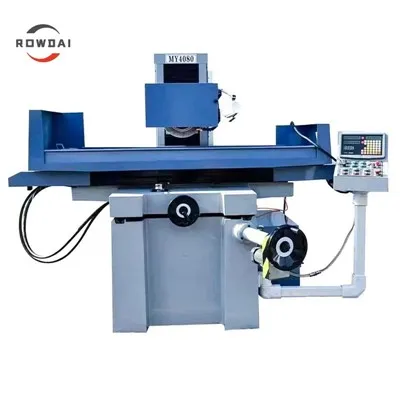
Hey everyone, and welcome back to the blog—thanks for stopping by! I’m Alex, and for those who don’t know me, I’m part of the team that builds and supports precision grinding machines, so I get asked about dry vs. wet grinding all the time. It’s one of those questions that sounds simple on the surface, but actually makes a huge difference in how your parts turn out, how long your machine lasts, and even what it costs to run. I’ve seen too many shops pick the wrong one and end up with rework, broken tools, or higher electricity bills, so let’s break this down like we would over a coffee at the shop floor—no boring textbook jargon, promise. Precision Grinding Machine
First, let’s get super clear on what each of these actually is, because some people mix them up with other processes. Wet grinding is when you pump a coolant (usually called “grinding fluid,” though it’s not just water) right to the point where the grinding wheel touches the workpiece. It floods the area, cools everything down, flushes away tiny metal shavings (called swarf), and even lubricates the wheel. Dry grinding? Yep, you guessed it—no liquid. Just you, the grinding wheel, the workpiece, and a little airflow to blow away swarf, if that. Sounds straightforward, but the differences run way deeper than that.
Let’s start with the big one: heat management. This is non-negotiable for precision work. When a grinding machine spins a wheel at thousands of RPM and presses it into metal, friction generates insane amounts of heat. Like, enough heat to melt steel in a tiny spot if it’s not controlled. For wet grinding, that coolant is the hero here. It’s not just water, by the way—most of the ones we sell use a synthetic or semi-synthetic fluid that has specific thermal properties to absorb heat way better than plain water. That heat gets carried away immediately, so the workpiece stays at a stable temperature. No thermal expansion, no warping, no softening of the metal’s surface layer (that’s called tempering, and it’s a disaster for tight tolerances). I had a customer last year who switched from dry to wet grinding for their aerospace turbine blades—they were getting 2 to 3 reworked parts a week because dry grinding was heating the edge just enough to mess up the hardness. Once they added our coolant system? Zero reworks in six months. Worth every penny of the initial setup.
Dry grinding, on the flip side? No liquid to absorb that heat. All that heat has nowhere to go but into the grinding wheel, the workpiece, and the machine itself. That means you have to slow down your feed rate or your wheel speed to keep heat from building up, which makes the process slower. And even then, you still get some heat-related issues. The wheel can wear out faster from the extra heat, because the abrasive grains (the grits that do the cutting) break down quicker when they’re hot. The workpiece expands while you’re grinding, and then shrinks back to room temperature afterward—so your tolerance, which you thought was 0.001mm, ends up off by a few microns. That’s the difference between a part that fits perfectly and one that gets rejected. We do sell some precision grinding machines for dry applications, but only for specific, low-tolerance parts or small batches where switching to wet isn’t feasible.
Next up: surface finish and part integrity. If you care about how the part looks or performs, this is another make-or-break point. Wet grinding gives a way smoother, more consistent surface finish, right? Because the coolant flushes away swarf before it can get dragged across the workpiece. Those tiny metal chips would scratch the surface like sandpaper if they’re left there, and the lubrication from the coolant also reduces friction between the wheel and the part, so the grits cut cleaner, not grind. For parts that need to be corrosion-resistant, too—like medical implants or automotive engine parts—the coolant can actually help prevent rust right there during grinding, which means less post-processing.
Dry grinding’s surface finish? It’s rougher, and you’ll get more of those tiny scratches and burrs because there’s no liquid to carry swarf away. You have to do extra deburring or polishing steps afterward, which adds time and cost. Also, that heat I mentioned earlier? It can cause micro-cracks on the part surface, especially in hard metals like tool steel or titanium. Those cracks are invisible at first, but when the part is in use (say, a gear in a transmission), they spread and cause failure. A lot of our medical device clients refuse to use dry grinding for implant parts because of that—can’t have a crack that could cause a patient issues down the line.
Swarf handling is another big one that people don’t think about until it’s a problem. Swarf is just the tiny metal bits you grind off, and you have to get rid of them somehow. Wet grinding’s coolant system has filters and pumps that catch the swarf, so it’s easy to collect, recycle, and dispose of properly. Most shops can even filter and reuse the coolant for months, which cuts down on waste. The downside? You have to maintain the coolant—top it off, test for contamination, replace it when it gets too dirty, and deal with the sludge that builds up. It’s not a huge hassle, but it’s more work than dry.
Dry grinding’s swarf is just powder or tiny flakes blowing around the shop. That sounds simpler, but let’s be real—dry metal particles in the air are bad for two reasons: first, they’re a fire hazard if they build up (especially for magnesium or aluminum swarf, which is highly flammable), and second, they get everywhere. In the machine, on the floors, in your employees’ lungs. I’ve seen shops where dry grinding was done and the entire machine’s electrical system was gummed up with swarf in a year, leading to expensive repairs. No such issue with wet grinding, because the coolant traps the swarf before it becomes airborne.
Then there’s machine and tool wear. Your precision grinding machine is a big investment, so you want it to last. Wet grinding actually helps protect it! The coolant acts as a lubricant for the spindle and the wheel head, reducing friction on moving parts. It also washes away swarf that would otherwise get into the ways or bearings of the machine, causing wear over time. Plus, the grinding wheel itself lasts longer with wet grinding—because the heat doesn’t break down the abrasive grains as fast. We recommend replacing wheels every 100 parts with wet grinding, vs. every 30 with dry grinding for the same job. That’s a huge cost savings on wheel replacements, which adds up fast.
Dry grinding? It’s way harder on the machine. The spindle and wheel head see more friction without the lubricant from coolant, and swarf getting into the machine’s crevices causes abrasion. The grinding wheel wears out super quick, so you’re buying new ones all the time, and you have to true and dress the wheel more often to keep it cutting straight. We had a customer who ran his old precision grinding machine on dry grinding for three years without maintenance, and the spindle had to be replaced because of heat and swarf damage. He could’ve avoided that with a simple coolant system, no joke.
Now, let’s talk about edge cases where dry actually makes sense—because it’s not all bad. Some shops use dry grinding for super small batches, like prototype parts, where setting up a coolant system isn’t worth the time or cost. Or for parts that can’t get wet—like electronic components that would short circuit if coolant gets on them. And in places where water or coolant is hard to come by, dry is the only option. But even in those cases, a lot of our customers will add a mist coolant system (which is halfway between dry and wet—uses a tiny amount of fluid) to cut down on heat. The key is knowing when that works, and when it doesn’t.
Cost breakdown is probably what’s on most of your minds, right? Let’s do a quick, real-world example. Let’s say you’re grinding 1,000 pieces of hardened steel, using the same precision grinding machine. Wet grinding setup: initial coolant system (we sell basic systems for our machines for under $1,500), coolant costs about $0.20 per part, wheel changes every 100 parts at $50 per wheel. Total for 1,000 parts: ~$2,200. Dry grinding: no upfront system, but wheels change every 30 parts at $50, plus extra deburring and polishing at $1 per part. Total for 1,000 parts: ~$2,100. Wait, that’s close—until you factor in rework. If dry grinding gives you 5% rework, that’s 50 parts you have to scrap or fix, adding $500 to $1,000. Suddenly wet is cheaper. And that’s not even counting the cost of machine repairs, fire hazard mitigation for dry swarf, or employee health issues from breathing in metal dust. That math usually shifts the balance pretty quickly.
A lot of people also ask about environmental impact. Wet grinding uses coolant, which has to be disposed of properly—you can’t just dump it down the drain, because it has chemicals. But modern coolants are recyclable, and most shops filter and reuse them for months, so waste is minimal. Dry grinding creates swarf dust, which is solid waste, but it’s just metal, so you can recycle it. The big environmental hit from dry is the energy use: you have to run the machine at lower speeds, so it uses more electricity per part, and wheel replacements mean more waste. Wet grinding uses less energy per part, and coolant waste is way smaller than wheel waste.
Wait, let’s wrap this up with something relatable. I was on a shop floor last week, talking to a machinist named Jake who’s been running grinding machines for 12 years. He told me, “Dry grinding feels faster in the moment, but by the end of the week, I’m exhausted from cleaning swarf out of the machine and dealing with rough parts that need rework. Wet is slow to set up, but I can run the machine and do other work while it’s grinding, because I don’t have to stop to clear swarf every two minutes.” That’s the real takeaway here. It’s not just about the numbers—it’s about how the process fits into your workflow.
So, when should you pick which? If you’re working on precision parts (tight tolerances under 0.005mm), hard metals, high-volume runs, or parts that need to be corrosion or crack-free? Wet grinding is non-negotiable. If you’re doing prototypes, small batches, parts that can’t get wet, or don’t need super tight tolerances? Dry might work, but weigh the extra rework and machine wear. And if you’re not sure, just ask the team here—we’ve helped hundreds of shops pick the right setup for their needs, whether they need a full wet system, a dry setup, or something in between.
At the end of the day, your precision grinding machine is an investment, so you want to make sure you’re using it in the way that makes your parts better, your shop more efficient, and your bottom line healthier. If you’ve been running dry and dealing with heat issues, or wet and the coolant’s not working for you, reach out—we can walk you through what your specific job needs, no sales pitch, just honest advice.

Thanks for reading—catch you next time on the blog!
Conventional Milling Machine References:
- Manufacturing Processes for Engineering Materials, Kalpakjian, S. and Schmid, S.R.
- Precision Grinding Technology Handbook, Society of Manufacturing Engineers (SME)
- Industrial Coolant Management for Machining Operations, National Institute for Occupational Safety and Health (NIOSH)
- Tool and Manufacturing Engineers Handbook: Grinding Processes, SME
Henan Rowdai Machinery Equipment Co., Ltd.
As one of the most professional precision grinding machine manufacturers in China, we’re featured by quality products and good price. Please rest assured to buy high-grade precision grinding machine for sale here from our factory. If you have any enquiry about cooperation, please feel free to email us.
Address: Building 9, E-Commerce Industrial Park, High-Tech Zone, Zhengzhou, Henan, China
E-mail: rowdai@rowdai.com
WebSite: https://www.rowdai.com/
