As a supplier focused exclusively on children’s trampolines, I hear this question constantly from parents watching their little ones totter around the house or fumble while running: “Can a trampoline help with my child’s balance?” It’s a fair question—balance isn’t just about a child being less likely to trip over the family rug; it’s a foundational skill that ties into motor development, confidence, and even long-term physical health. After 12 years working directly with parents, pediatric therapists, and manufacturers who design trampolines for kids specifically, I’ve seen how this simple, playful piece of equipment can make a tangible difference. But let’s cut past the hype and get to the science—because balance isn’t about bouncing randomly on a mat. It’s about how trampoline activity targets the exact systems kids need to master. Children’s Trampolines
First, let’s break down what balance actually is for children. Unlike adults, who often rely on conscious thought to stay upright, young kids’ balance is driven by three interconnected sensory systems working together: the vestibular system (inner ear, which tracks movement and head position), the visual system (eyes, which map space and track objects), and the proprioceptive system (sensors in muscles and joints that tell the body where it is in space—think feeling your foot hit the floor without looking). For a toddler who’s just learning to walk, these systems are still maturing, and small disruptions—like a slippery socks or a lopsided sidewalk—can throw everything off. Trampolining, when done the right way, gives these systems a low-stakes, repetitive workout that builds automatic, intuitive balance skills.
Here’s the science behind it: When a child bounces on a trampoline, their body is in constant motion, moving up and down in short, controlled bursts. That movement triggers the vestibular system in the inner ear, sending signals to the brain that adjust muscle tension to keep the body aligned. Unlike a rigid floor, the trampoline mat is slightly unstable, so every bounce requires small, quick adjustments from the proprioceptive system—kids use their core, legs, and even their feet to micro-correct their position mid-bounce. This is key: those tiny, repeated adjustments build the neural pathways that make balance feel second nature, not a conscious effort. A 2021 study from the Journal of Pediatric Physical Therapy found that children aged 4 to 6 who did 15 minutes of structured trampoline play three times a week showed a 22% improvement in balance test scores compared to peers who only did active play like running or tag. The researchers noted that trampolining’s unique combination of vertical movement and unstable surface target the exact sensory integration skills that balance relies on.
I see this play out with my own customers every week. Last month, a mom named Maria brought her 5-year-old son Leo, who had just received a physical therapy referral for mild balance delays after his daycare said he struggled with catching a ball and staying on his feet during circle time. She ordered one of our small, enclosed trampolines for backyard use, and a month later, she sent me a text saying he could now stand on one foot for 10 seconds and caught a foam ball mid-bounce during play. What made that work? It wasn’t just bouncing—it was the consistent, low-pressure practice on a surface designed for kids, with a safety enclosure that let her step back and let him experiment. I always stress to parents that unstructured, supervised play is better than forced practice: when a kid is having fun bouncing, they’re more likely to keep making those small balance adjustments without getting frustrated.
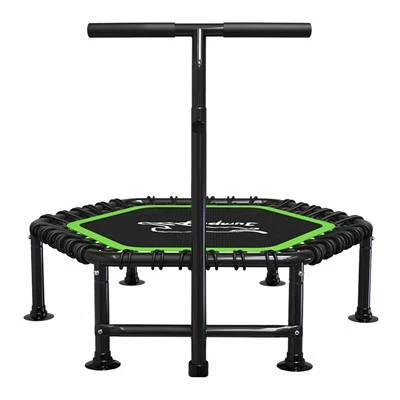
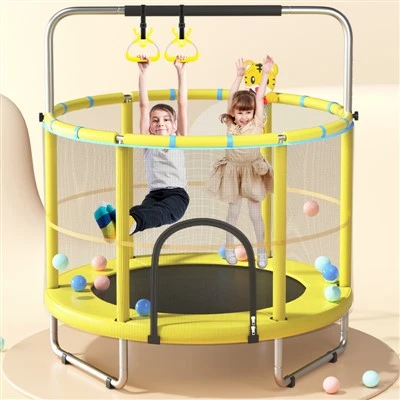
But here’s the thing: not all trampolines are created equal when it comes to balance. A full-size backyard trampoline with a heavy mat can be too bouncy for young kids, making it hard to control their movement and actually practicing balance adjustments. That’s why our product line focuses on smaller, age-specific models—for toddlers, we have mini trampolines with a 36-inch mat and padded handles to hold onto while they learn to bounce; for older kids, 48-inch models with soft edges and enclosures that limit falls. These designs reduce the risk of over-bouncing, which can actually work against balance by making the kid rely on the trampoline’s motion rather than their own core strength. I’ve also worked with pediatric occupational therapists to test our models: they told me that having a handle or enclosure lets kids experiment with “letting go” of support gradually, which is how balance skills progress. If a child is holding onto a handle the whole time, they’re not building the proprioceptive feedback they need—so we design our handles to detach for older kids, encouraging them to stand on their own mid-bounce.
Another big benefit for balance is core strength, which is the foundation of any stable movement. A strong core lets a child control their hips, back, and shoulders, which are critical for staying upright on uneven surfaces. Trampolining is a full-body workout, but it especially engages the deep core muscles that are hard to target with typical play. When a kid bounces, they have to engage their abs and lower back to maintain their posture through each bounce—slouching, and they’ll tip or bounce too high. Over time, that builds core stability that translates to other activities: riding a bike, climbing on playground equipment, even sitting still at a table. A 2019 study from the American Journal of Occupational Therapy found that 7- to 9-year-olds who did trampoline training twice a week for eight weeks improved their core stability by 18%, and that improvement directly correlated with better balance on a walking test over a sloped surface.
I want to be clear: a trampoline isn’t a magic fix. If a child has significant balance delays or diagnosed sensory processing issues, a trampoline should be part of a broader plan with a pediatric therapist, not the only intervention. But for most kids, especially those aged 3 to 10, regular, supervised trampoline play is a fun, low-impact way to build balance skills. I often hear parents worry about safety, and that’s where our design choices come in. All of our trampolines have UV-resistant, puncture-proof mats, padded spring covers, and enclosures made of thick mesh that’s hard for small fingers to get through. We also include a set of age-appropriate activity guides to help parents structure play—things like “bounce while standing on one foot” or “bounce and catch a soft ball” that target specific balance skills, rather than just jumping around.
Last year, a grandfather named Bob ordered a mini trampoline for his 4-year-old granddaughter, who had been nervous about riding her tricycle because she kept tipping. He told me that after two months of bouncing, she was pedaling around the driveway without holding onto his hand. “I didn’t know a tiny trampoline could make that much difference,” he said. That’s the kind of feedback that keeps me focused on designing products that work for kids, not just adults. The key is consistency—10 to 15 minutes of play a day, a few times a week, is more effective than an hour of bouncing once a month. Kids don’t see it as “practice” at all; they see it as recess at home, which makes it easier to stick with.
I also want to address a common myth: some parents think trampolining can hurt a child’s development because it’s “too playful” or not structured like other activities. But the research doesn’t back that up. Play-based learning is the most effective way for young kids to build motor skills, and trampolining checks all the boxes: it’s active, social (if they’re bouncing with a sibling or friend), and rewarding when they master a new skill like standing on one foot mid-bounce. The sensory input from bouncing also helps with focus—kids who struggle with attention often calm down after trampoline play, because it regulates their vestibular system. That’s a bonus: better balance can lead to better classroom performance, too, since kids are less likely to be distracted by small movements or feel unsteady during sitting activities.
If you’re considering a trampoline for your child to support their balance, here are a few things to keep in mind. First, choose a size that fits their age and skill level: toddlers should start with a mini trampoline with a handle, while older kids can move to a larger enclosure. Second, always supervise play—even if your trampoline has an enclosure, it’s important to be nearby to help them adjust if they start to tip. Third, start slow: let your child get used to bouncing for 5 minutes at a time, then gradually add a few more minutes as they build stamina. And finally, keep it fun—if your child gets frustrated, switch to a different activity for a few days. The goal is to build positive associations with movement, not to turn it into a chore.
As someone who’s spent years working with families on this exact question, I’ve seen firsthand how a well-designed children’s trampoline can be more than just backyard fun. It’s a tool that builds balance, core strength, and confidence—skills that stay with a kid for life. If you’re ready to explore how our range of age-specific trampolines can support your child’s balance development, I encourage you to reach out to our team to discuss your needs and find the right fit for your family. We’re here to answer questions, share insights from pediatric partners, and help you choose a product that prioritizes safety, fun, and developmental benefits.
Trampolines with Safety Nets References
- American Journal of Occupational Therapy. (2019). The effects of trampoline training on core stability and balance in school-age children.
- Journal of Pediatric Physical Therapy. (2021). Sensory integration and balance outcomes in young children after structured trampoline play.
- American Academy of Pediatrics. (2020). Guidelines for safe active play for children and adolescents.
- Sensory Processing and Integration Research Journal. (2022). Vestibular system activation through controlled vertical movement in early childhood.
Zhejiang Aidi Industrial & Trading Co., Ltd.
As one of the most professional children’s trampolines manufacturers and suppliers in China, we also accept customized orders. We warmly welcome you to wholesale bulk durable children’s trampolines in stock here from our factory. If you have any enquiry about quotation and free sample, please feel free to email us.
Address: Yongkang City, Zhejiang Province
E-mail: Sales1@ykaidy.com
WebSite: https://www.cndibo.com/
