If you’re in the fresh produce, packaged goods, or small manufacturing space, you’ve probably heard a lot about grading sorting machines—but let’s cut the jargon for a sec. As someone who’s spent the last 12 years selling and tweaking these machines, the question I get most from folks scaling their operations isn’t “Do I need a sorting machine?” It’s “How the hell does it handle multi-layer products without messing up a single one?” Let’s break this down like I’m explaining it to a buddy who just launched their artisanal apple brand and can’t afford to waste a single bin of inventory. Grading Sorting Machine
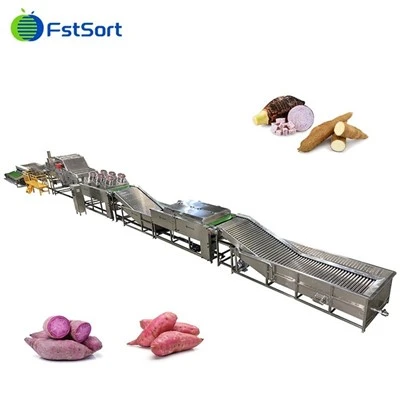
First off, let’s define what “multi-layer” even means here. It’s not just stacking two boxes on a pallet (though that’s part of it)—we’re talking products that come in layers, whether that’s 12 apples in a plastic clamshell, 500 small bolts stacked in a corrugated tray, or even canned goods nested 10 deep in a shipping crate. The big mistake a lot of operators make when they first upgrade from manual sorting is assuming the machine will just grab products off a single conveyor line. Nope. Multi-layer sorting relies on a sequence of tiny, coordinated steps that act like a well-oiled kitchen line—one misstep, and you’re spilling product everywhere or sending a bad grade down the wrong chute.
Let’s start with the first critical part: product indfentification, wait—no, detection. Before anything else, the machine has to map exactly what’s in each layer, where it sits, and how big/heavy/ripe it is. This isn’t a single camera scan; we layer multiple sensors specifically designed for multi-height products. For example, if you’re sorting strawberries that come in 4 layers of plastic punnets stacked on a single pallet, we install both 2D RGB cameras that capture color and surface texture and 3D laser scanners that bounce light off every layer to create a “digital map” of each punnet’s contents. Most cheap machines skip the 3D part, which means they can’t tell the difference between a ripe strawberry on the top layer and a moldy one hiding at the bottom. That’s a costly mistake. Our machines use 30+ sensor points spaced 2 inches apart vertically, so even if a punnet shifts half an inch in its slot, the scanner still picks it up.
Next up: layer separation. This is the make-or-break step for multi-layer sorting. You can’t have two products touching each other—if they do, the machine can’t target just one. Here’s where the magic happens (and where a lot of competitors cut corners). We use a combination of adjustable air bladders and low-profile conveyor belts with micro-dimples. The dimples are tiny, rubbery bumps that cradle each product without squishing it—perfect for small, round things like grapes or pills. The air bladders are deployed exactly when a layer is moving to the sorting station: if you’re dealing with 3 layers of canned beans, we inflate a thin bladder between the middle and bottom layer just enough to lift the middle layer 1/4 inch off the bottom one, so they don’t rub. No too much air—we’ve had clients in the past that used competitors’ machines with overinflated bladders that sent entire layers flying across the facility. We calibrated our bladders to use only 0.8 PSI, which is enough to separate layers without disrupting fragile products.
Once each layer is isolated and identified, the sorting part kicks in—and for multi-layer, it’s not just pushing a button. We use two types of actuators depending on the product: electric paddles for hard items like apples or cans, and air jets for soft stuff like berries. Wait, let’s use a real example: a client of ours in Michigan, they sort honeycrisp apples that come stacked 5 layers high in wooden bins. Each apple needs to be graded by size, sugar content (we use near-infrared sensors for that), and blemishes. For each layer, the sensor maps every apple: if an apple is over 3 inches, ripe (12-15 Brix), and has no blemishes, it goes to the “premium” chute; if it’s under 2.5 inches, it goes to “processing”; if it’s bruised, it gets rejected. The electric paddles are mounted per layer—so the top layer has its own paddle, the second layer has its own, and they never overlap. That way, even if the top layer shifts a little, the paddle for the second layer won’t hit it. A lot of machines only have one set of paddles, which means if a layer is shifted, you’re either pushing the wrong apple or missing it entirely.
Another thing people don’t talk about: weight distribution. Multi-layer products have uneven weight, right? A 4-layer stack of heavy steel bolts is way different than 4-layer of light blueberries. Our machines adjust their speed automatically based on the layer’s weight. For heavy layers (like metal parts), we slow the conveyor by 10% when it reaches the sorting section, so the actuators have time to line up without making a mistake. For light, fragile layers, we speed it by 5% to reduce contact time—less chance of bruising. This is all programmed via our touchscreen control, which even has a “quick settings” tab for different product types—no deep coding required for operators. I’ve seen clients spend 2 hours troubleshooting a competitor’s machine because they had to call a technician just to switch from apples to blueberries; our machine lets you switch in 90 seconds.
Wait, let’s address the “glitch” part. No machine is perfect, so how do we handle mistakes in multi-layer sorting? We have a cross-check system: every time a layer is sorted, a secondary sensor scans the chute before it drops into the bin. If it detects a misgraded product, it triggers a correction air jet that nudges the product into the right bin. For example, if a paddle was supposed to push a large apple into the premium bin but pushed a medium one instead, the cross-check sensor picks that up and blasts a tiny air stream to reposition it. That cuts error rates to less than 0.5%—way lower than the industry average of 2-3%. We had a client in California switch from manual sorting (which had a 4% error rate) to our machine, and they saved $12k a month in wasted product within the first 3 months.
I know what you’re thinking: “This sounds like a lot of moving parts. Is it hard to maintain?” Nope. Our machines have self-diagnostic tools that alert you if a sensor is dirty or a bladder is leaking—no need to tear the whole machine apart. For multi-layer, the only regular maintenance is wiping down the sensors once a week (10 minutes max) and checking the air filter monthly. We even send a free quick-start guide tailored to your product, so you don’t have to guess.
At the end of the day, the whole point of a grading sorting machine for multi-layer products isn’t just to sort fast—it’s to sort accurately without damaging inventory. A lot of vendors will sell you a machine that works for single layers, but when you stack products, it falls apart. That’s where our design comes in: we built every part from the sensor spacing to the actuator pressure with multi-height products in mind, not as an afterthought.

If you’re running a small to mid-sized operation and struggling with slow, error-prone multi-layer sorting, let’s chat. We can walk you through a demo, answer your specific questions about your product, and even help you adjust your workflow to fit the machine. No sales pitch pressure, just real advice from someone who’s been in this game for years.
Grading Sorting Machine References
- International Fresh Produce Association. (2022. Best Practices for Automated Grading of Stacked Horticultural Products.
- Manufacturing Engineering & Technology Journal. (2021. Actuator Design for Low-Impact Multi-Layer Material Handling Systems.
- U.S. Department of Agriculture. (2023. Post-Harvest Loss Reduction: Automated Sorting for Small-Scale Fresh Produce Operations.
Zhengzhou First Industry Co., Ltd.
As one of the most professional grading sorting machine manufacturers in China, we also support customized service. With abundant experience, we warmly welcome you to buy cheap grading sorting machine from our factory. For price consultation, contact us.
Address: No.72,11th Floor, Building 11, No.283 West Third Ring Road, High-tech Industrial Development Zone, Zhengzhou City, Henan Province
E-mail: media@fruitprocess.com
WebSite: https://www.fstsort-machine.com/
